.png)

Yoga Through Menopause: A Gentle Path to Strength, Mobility & Inner Calm
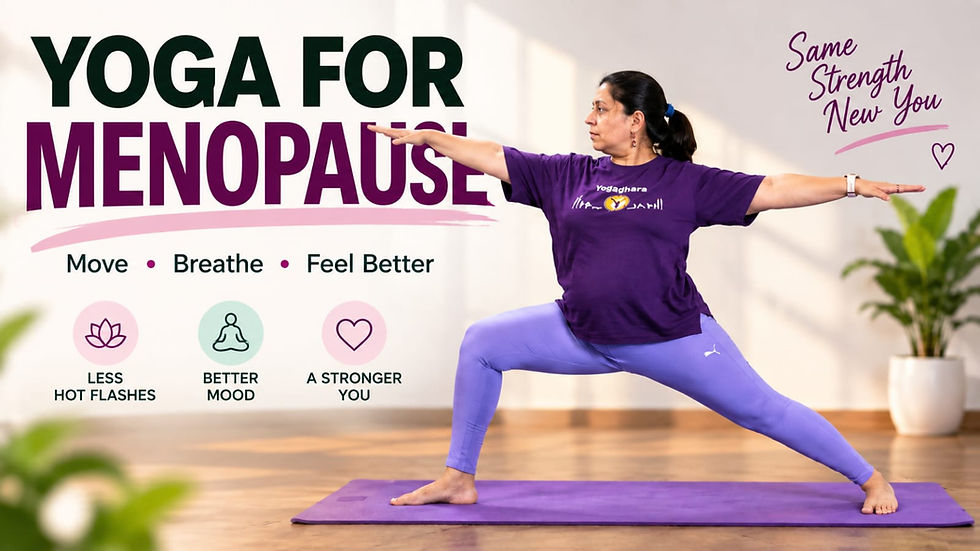
A practical, compassionate yoga routine for women in their 50s navigating hot flashes, mood changes, stiffness and the emotional shifts of menopause
Menopause is a transition—not a loss of vitality. The aim of yoga is not to “fix” hormones, but to help you feel more comfortable, mobile, strong and settled while your body adapts. |
When the body changes, the practice can change too
For many women, the 40s and 50s bring a noticeable change in the way the body feels. Hot flashes, night sweats, disturbed sleep, mood changes, irritability, fatigue and a sense of physical discomfort can appear alongside changes in the menstrual cycle. Some women also notice more stiffness, reduced mobility or aches in the shoulders, hips, knees and spine.
This is not a time when yoga needs to become more demanding. In fact, a thoughtful menopause practice can become more intelligent: less about pushing, more about listening; less about performance, more about creating space, strength and calm.
What can yoga realistically do?
Research on yoga during menopause is encouraging, but it is important to be precise about what the evidence shows. A 2024 systematic review and meta-analysis of 24 randomized controlled trials involving 2,028 women found that yoga was associated with improvements in overall menopausal symptoms, psychological symptoms, somatic symptoms, sleep quality, anxiety and depressive symptoms. However, that review did not find a statistically significant benefit for hot flashes specifically or for quality of life. Earlier reviews have reported mixed findings, which means yoga should be viewed as a supportive practice—not a replacement for medical care or a guaranteed treatment for every symptom.
The most useful way to think about yoga is as a whole-person practice: movement can maintain mobility and physical capacity; strength work can support muscles and function; breathing and meditation can create a deliberate pause for the nervous system; and regular practice can give the day a dependable rhythm.
Start the morning by creating movement—not pressure
After sleep, the body can feel tight and slow to “switch on.” A few minutes of gentle joint and mobility work can be an excellent beginning. The goal is not to stretch aggressively. The goal is to move the joints through comfortable ranges and remind the body that movement is safe and available.
● Shoulder rotations and gentle shoulder-opening movements to reduce the feeling of upper-body tightness.
● Neck mobility performed slowly and within a comfortable range—never forcing the neck into end-range positions.
● Butterfly movement with easy, relaxed hip motion rather than pressing the knees down.
● Gentle 90/90 hip mobility, adapted to the individual’s comfort and range.
● Simple Sukshma Vyayama practices for wrists, ankles, knees, shoulders and other joints.
● Gentle spinal movements, coordinated with relaxed breathing.
Think of this sequence as oiling the hinges of the body. Five to ten unhurried minutes can make the rest of the morning feel very different.
Surya Namaskar: keep the flow, reduce the strain
Surya Namaskar can be included in a menopause-friendly routine, but it does not have to be fast, deep or physically demanding. One or two slow rounds, performed with steady breathing and attention to the body, may be enough for some women.
If getting down to the floor or moving through the full sequence feels uncomfortable, a chair version of Surya Namaskar is a very practical alternative. Chair Surya Namaskar can retain the rhythm of coordinated movement and breathing while reducing the physical demand of transitions. The right version is the one that allows you to move with control rather than struggle.
Strength matters in your 50s
A menopause routine should not be only stretching and relaxation. Maintaining strength becomes increasingly important for everyday function and long-term musculoskeletal health. WHO recommends that adults include muscle-strengthening activity involving major muscle groups on at least two days each week.
Yoga can be combined with simple resistance and bodyweight exercises. Depending on fitness level and medical considerations, a gentle sequence might include:
● Chair squats or supported squats for the legs and hips.
● Wall push-ups for the chest, shoulders and arms.
● Supported plank holds or modified plank variations for whole-body strength.
● Controlled leg-strengthening movements using a chair or wall for balance.
● Bhujangasana (Cobra Pose), practiced gently and without forcing the lower back.
● Dhanurasana (Bow Pose) only when it is comfortable and appropriate for the individual.
● Gentle lying spinal twists, keeping the movement controlled and pain-free.
Strength work should feel purposeful, not punishing. Start with a manageable amount and gradually build. If you have osteoporosis, significant joint pain, a recent injury, cardiovascular disease, uncontrolled blood pressure or another medical condition, get individualized guidance before adding demanding exercises or deep yoga postures.
Pranayama: create a softer internal rhythm
When the mind feels overstimulated, the practice can shift from movement to breath. Anulom Vilom (alternate-nostril breathing) can be practiced gently, without breath retention or force, especially by beginners. Bhramari (humming-bee breath) can provide a soothing, attention-focusing practice for people who find the vibration and slow exhalation calming.
The intention is not to claim that pranayama “balances hormones.” A more accurate description is that slow, comfortable breathing and relaxation practices may help with perceived stress and emotional regulation. The evidence for mind-body approaches in menopause is promising but not uniform, so these practices are best used as supportive tools.
Five minutes of meditation can change the tone of the day
Meditation does not need to mean emptying the mind. Sit comfortably, soften the face and shoulders, and observe the natural breath. For five minutes, each time the mind moves toward irritation, worry or planning, gently return attention to the breath.
This small practice creates a valuable gap between a sensation and a reaction. Over time, that pause can become one of the most useful parts of a menopause wellness routine.
A simple 25–30 minute menopause-friendly morning practice
Practice | Suggested time | Purpose |
Sukshma Vyayama + joint mobility | 5–7 min | Wake up the joints; reduce morning stiffness |
Slow Surya Namaskar / chair version | 4–6 min | Whole-body movement, coordination and gentle warmth |
Strength practice | 6–8 min | Support muscle strength and functional movement |
Gentle asana + spinal mobility | 3–4 min | Comfortable range of motion and release |
Anulom Vilom + Bhramari | 3–5 min | Slow the breath and settle attention |
Meditation | 5 min | Quiet reflection and mental reset |
Listen to the body: menopause is not a competition
Some mornings you may feel energetic. On another day, you may feel tired, warm, stiff or emotionally sensitive. A good practice can adapt. Reduce the number of rounds, use a chair, shorten the holds, rest more, or simply spend longer with gentle mobility and breathing.
Pain is not a sign that the practice is working. Dizziness, chest pain, unusual shortness of breath, fainting, severe headache or significant new pain are reasons to stop and seek appropriate medical advice.
The deeper goal: feeling at home in your changing body
Menopause can be approached as a season of recalibration. Yoga gives you a way to participate in that process consciously. Move the joints. Build strength. Breathe slowly. Rest when you need to. Sit quietly for five minutes. Repeat tomorrow.
The objective is not to make your body behave as though nothing has changed. It is to help you move through change with greater awareness, mobility, strength and calm.
A sustainable weekly rhythm
● Daily: 5–10 minutes of gentle mobility and joint movements.
● 3–5 days/week: yoga practice combining mobility, asana and relaxed breathing.
● 2 or more days/week: dedicated muscle-strengthening work, adjusted to ability and health status.
● Daily: 5 minutes of meditation or quiet breathing.
● Throughout the week: walking or another enjoyable form of moderate physical activity as appropriate.
Important note
Yoga can be a valuable complementary practice during menopause, but it does not replace medical assessment or evidence-based treatment. Persistent, severe or new symptoms—including very heavy bleeding, significant depression or anxiety, chest pain, unexplained weight loss, severe sleep disruption or concerning pelvic symptoms—deserve discussion with a qualified healthcare professional.
Evidence behind this article
Tang S-Y et al. The effectiveness of yoga on menopausal symptoms: a systematic review and meta-analysis of randomized controlled trials. 2024. PubMed PMID: 39467491.
Cramer H et al. Yoga for menopausal symptoms—A systematic review and meta-analysis. Maturitas. 2018.
Cramer H et al. Effectiveness of yoga for menopausal symptoms: a systematic review and meta-analysis of randomized controlled trials. 2012.
Newton KM et al. Mind-body therapies for menopausal symptoms: a systematic review. Maturitas. 2010.
The Menopause Society. 2023 Nonhormone Therapy Position Statement.
World Health Organization. Physical activity recommendations for adults.
Research note: Evidence on yoga and menopause has evolved. Some reviews report meaningful improvements in overall or psychological symptoms, while authoritative menopause guidance has noted insufficient evidence to recommend yoga specifically as a treatment for vasomotor symptoms such as hot flashes. This article therefore presents yoga as supportive care and does not claim hormonal correction or guaranteed symptom relief.


Comments